Faculties




Prosthodontics and Crown & Bridge
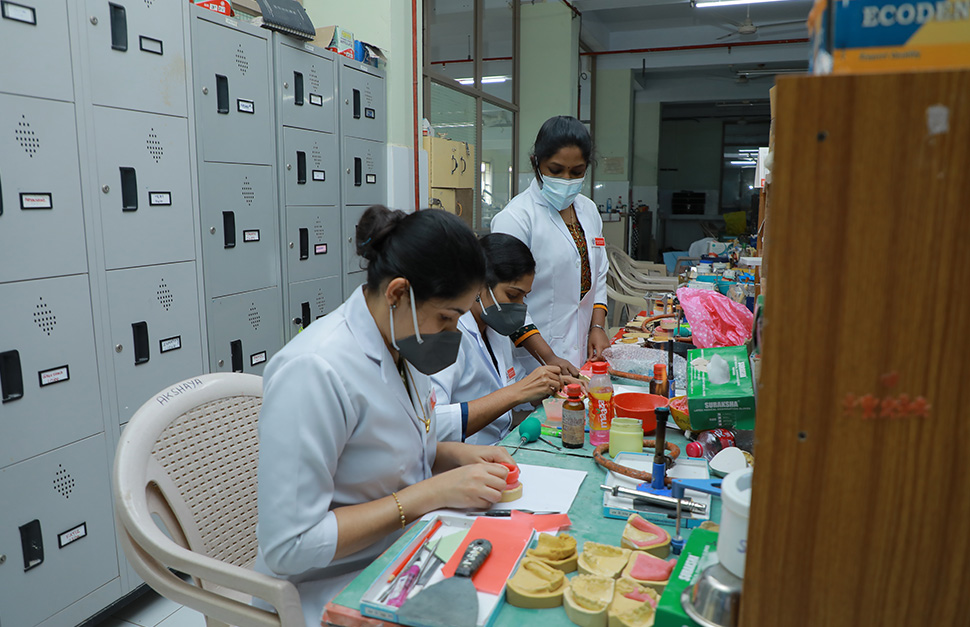
The speciality of prosthodontics is the amalgamation of art and engineering with dental medicine. This most happening speciality of dentistry deals with rehabilitation and maintenance of oral function, while ensuring comfort, appearance, and health of the patients. This is a branch that has exploited the scope of modern digitisation and artificial intelligence to the maximum. The department offers comprehensive training for the aspiring dentists. The Undergraduate program includes theory lectures and clinical training. Beginning with pre-clinical practical training in complete denture and partial denture construction on stone models in the first two years, followed by treatment procedures carried out on actual patients under the able guidance of the teachers, the students are trained to treat completely edentulous and partially edentulous patients with removable prosthesis. Various activities are also included in the curriculum like fun with dental materials, teeth setting competition etc to make learning more enjoyable.Types of Prosthodontic Treatments
Oral restoration treatment using prosthodontic appliances that are fixed into the patient’s mouth is known as fixed prosthodontics. Dental Crowns, Dental Bridges, Inlays, and Veneers are common examples of fixed prostheses.
Complete or partial dentures that replace a missing tooth/teeth in a patient’s mouth and can be removed and cleaned easily are known as removable prosthodontic appliances.
Highly specialized treatment procedures related to cleft lip and palate of the mouth, pinna (the external part of the ear), nose, eye, and chin come under maxillofacial prosthodontics. Prostheses such as Speech Bulbs, Palatal Lifts, Obturators, and Palatal Augmentation Devices are used in the treatment.
When a patient has issues with missing tooth roots, he/she will need dental implants which are sturdy, rigid screw / cylinder-like structures that provide support and durability to a dental bridge, denture, or maxillofacial prosthesis.
Benefits of Prosthodontic Care
01
Aesthetic restoration after an injury or accident trauma
02
Functional restoration for optimising bite, chewing and digestion, speech issues, and sleep disorders
03
Conservation of tissues damaged due to dental decay.
04
Oral reconstruction after chronic illnesses like cancer
Advances in Prosthodontic Technology
The most significant advancement in prosthodontics, and in dentistry in general, has to be the integration of digital technology into dental practice. The use of CAD / CAM technology and 3D printing have revolutionized the design and fabrication of dental prostheses, improved the quality and precision of the appliances, and reduced the turnaround time for treatment.
There have also been improvements in the prosthodontic materials being used in dental restorations. Biomimetic materials that are designed to mimic the natural composition of tooth enamel and dentin enable prosthodontists to provide restorations that look like the patient’s natural teeth and are functionally compatible. High-performance prostheses made of advanced polymers and reinforced ceramic composites have also gained popularity due to their strength and durability, and are being used in bridges and crowns for posterior teeth where high stress resistance is required.